Patricio P. Pouchulu
a r c h i t e c t
Patricio Pedro Pouchulu (Buenos Aires, 1965) is an organic architect known after his grand designs and competition projects. His evocative work is devoted to the exploration of unknown architectural territories and contemporary utopias.
He transformed buildings in London, applying organic principles, with emphasis on flexibility, re-instating historical architectural concepts. Since 1981 Pouchulu designed more than two hundred buildings.
His body of work deals with a wide range of topics, themes, places. Cities: London Bridge; Nature: House in a Cliff; Resting & Leisure:Mirador de Atardeceres; Offices: The Lift; Museums:Grand Egyptian Museum.
Graduated at the Bartlett School, UCL, University College London and FADU, he was recognized by the British Council, and was invited to write articles in the UK Parliament, promoting ARG-UK partnership.
Pouchulu taught in Munich (FH), London (UCL), Buenos Aires (UBA). He wrote books about Organic Architecture and Habitat Change. Co-founder of Cyclotel Holding B.V. in the Netherlands.
He is an art collector, book lover, painter, filmmaker, Helmsman (PNA), narrowboat enthusiast, and Honorary Member of Instituto Aeronaval, Argentine Navy, Air Wing. up
....
. .
CUNCTI ADSINT MERITAEQUE EXPECTENT PRAEMIA PALMAE
ARGENTINA VIRTUS ROBUT ET STUDIUM
INSTITUTO AERONAVAL
Selected Works
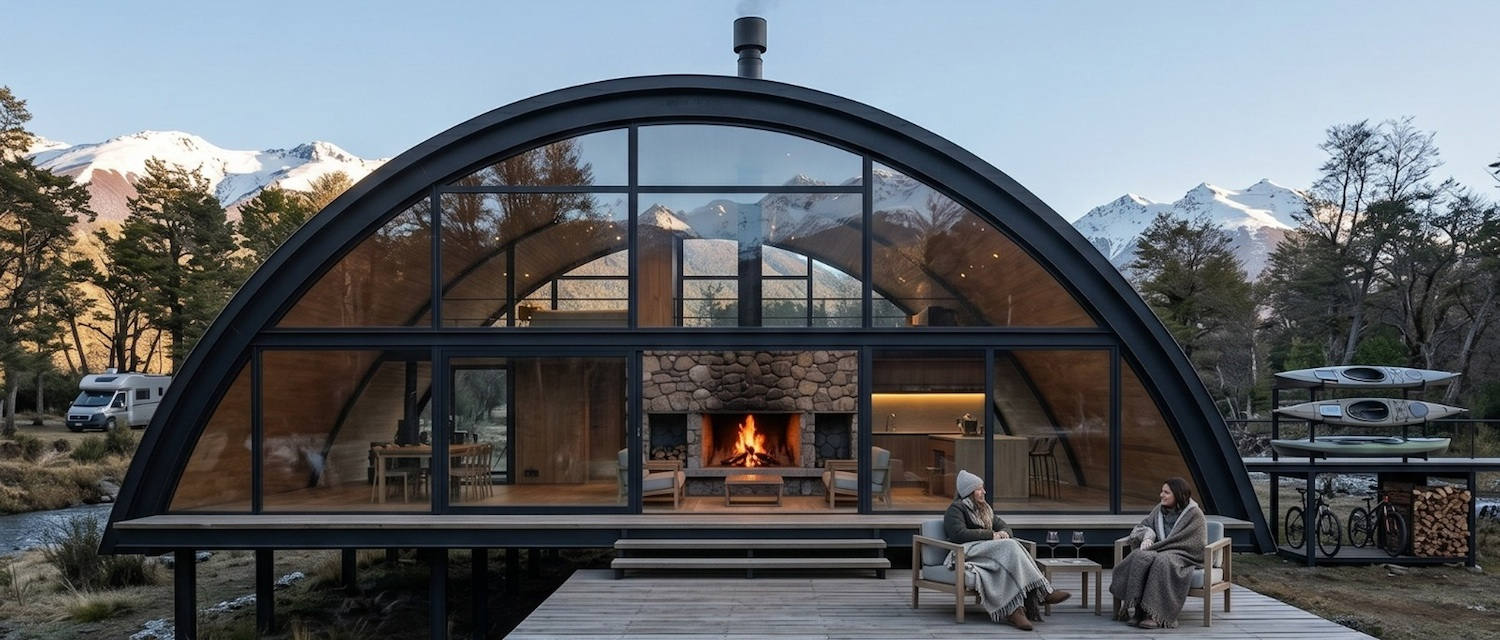
Digital rendering, Bungalow in winter. Copyright © 2022 PPPouchulu.
Bungalow, Patagonia, 2022
This Bungalow can be adapted to different locations and is composed by three elements: an arched roof, a platform, and a single central volume, thick wall that organizes the space and contains all the infrastructure: a large fireplace, bar, book shelves, kitchen, and the staircase that leads to the bedroom on the upper floor.
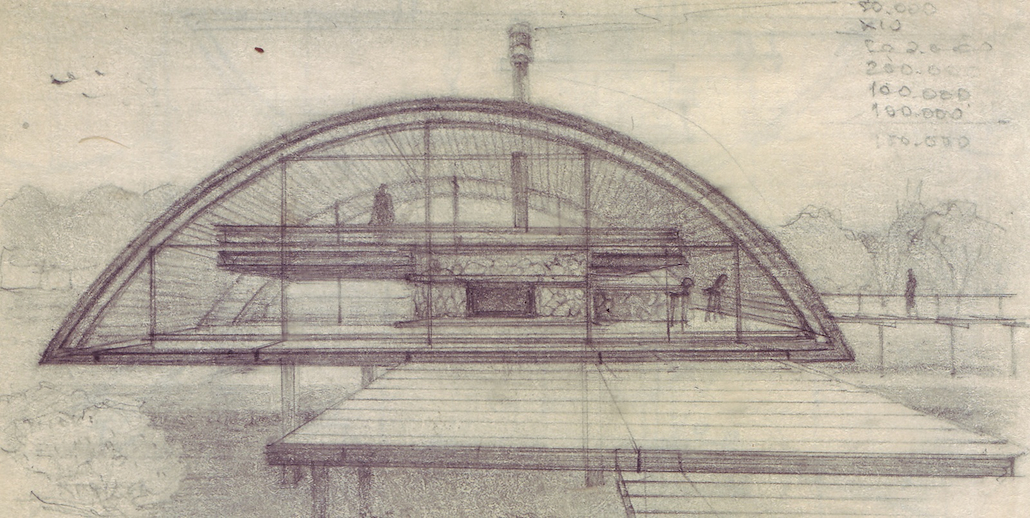
Preliminar sketch, Bungalow.. Copyright © 2022 PPPouchulu
The structure on the platform allows easy mounting. The modular surrounding deck can expand according to the client's needs. The fireplace works as central heating, burning local wood from renewable forests, the most sustainable source of heating. up

Perspective, Cyclotel Station in Northern Europe. Copyright © 2021 PPPouchulu
Cyclotel Stations, Europe, 2020-30
The Cyclotel Stations are clusters made of cabins. A full cluster can reach 21 modules. These Stations will link two Cyclotel Units in longer cycling routes or where there is more demand for overnight cyclotourists: they are easy to transport and mount. Each cabin (15m2) offers two beds, sofa-bed, full bathroom and cooking-eating area. Cabins can be connected with each other by a half-level hatch, up or down, for longer groups or families, creating many combinations. up

Perspective, Cyclotel Base, the Netherlands. Copyright © 2017 PPPouchulu
Cyclotel Base, Europe, 2018-30
This Cyclotel is an extended version of the standard unit developed between 2007 and 2012. Each building is modular and forms a 16 cabins loop, up to (maximum) of 100 cabins.
Like the former version, it can be placed in any cycling route; however, as it is the anchor unit, it stands beside cities and train stations. up

Photomontage on aerial photo. Crystal Dome access and the existing MNBA. Copyright © 2015 PPPouchulu
MNBA/Moderno, Buenos Aires, 2016
The MNBA, Museo Nacional de Bellas Artes (National Gallery), holds the biggest art collection in the Southern Hemisphere (13.000 art pieces, 3.000 fine canvas), but holds unsolved urban and architectonic problems. In 2005 its former director Jorge Glusberg asked Pouchulu a concept to expand the building. After a few months, he presented a large underground extension and a new access.
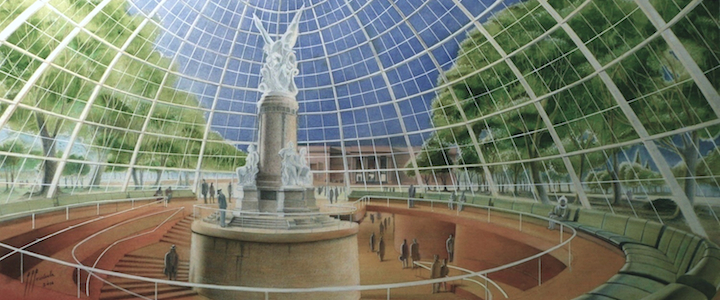
Perspective, Grand Crystal Dome access; MNBA in the background. Copyright © 2015 PPPouchulu
First, the entrance was relocated across Libertador Avenue in Plaza Francia, through a Crystal Dome over the extraordinary French monument. By doing this, the museum will attract a percentage of the 250.000 visitors that visit Recoleta every day. Second, the new space is located under Libertador avenue, showing the 20th and 21st Century collections. The existing Museum, an old pumping station transformed in 1932 by Alejandro Bustillo, is left intact and will host the 19th century and pre-Columbian art. Third, by placing a large car parking complex, art shops and amenities, the museum will become sustainable. The scheme includes restoration and conservation rooms, an auditorium-cinema, interactive areas and a Piazza-cafe.
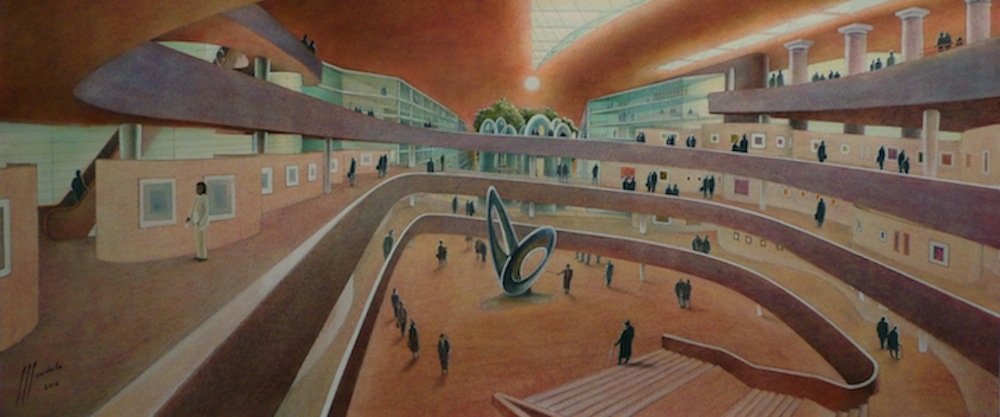
Perspective, new exhibition space. Copyright © 2016 PPPouchulu
Buenos Aires, cultural capital of the southern Hemisphere, receives more than 6.000.000 tourists per year, surpassing any other city or country in the sub-continent. This addition of 11.000 squares metres will double the MNBA's area and quintuple its visitors. up
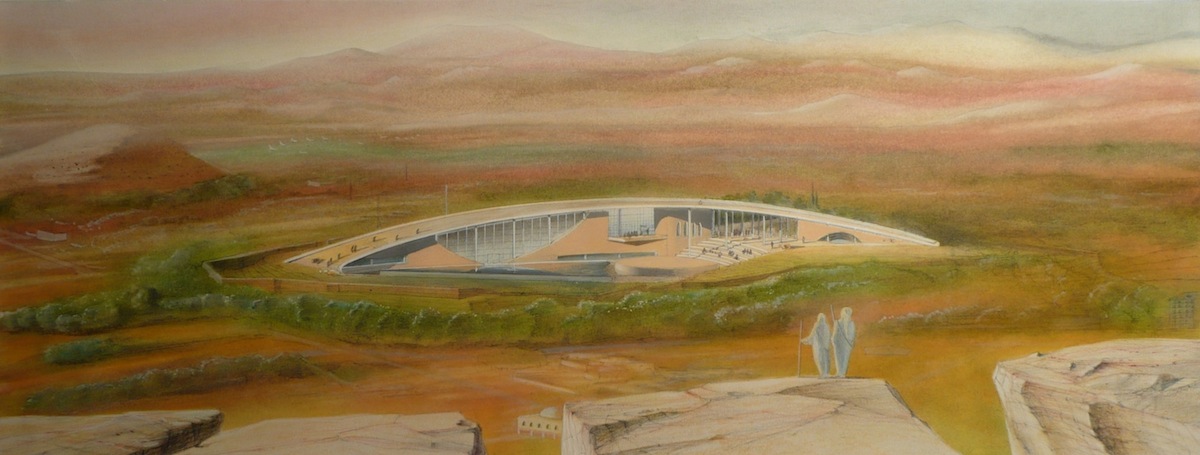
Bird's eye perspective from the Cliff. Copyright @ 2015 PPPouchulu
Bamiyan Centre, Afghanistan, 2015
The Bamiyan Cultural Centre is a bridge, because it connects past and future, allowing visitors to walk on its roof, reaching the great Buddah Cliff view in permanent dialogue with the valley's history. The building develops a single space, following the rich sheltered bazaar typology: this honours one of the most important eastern anthropological qualities that explains the islamic spirit: the journey. A grand amphitheater, articulating the upper and the lower site levels, transforms the Valley in a natural stage. After crossing the columnated lobby and hall, visitors submerge in a trip, softly descending through exhibition terraces, surrounded by the Tea House (Glass Cube), Permanent Exhibition, Research and Library, reaching the lower level, Temporary Collections: there they watch the Buddah Cliff -mirrored on a water pool- through the large curved window.
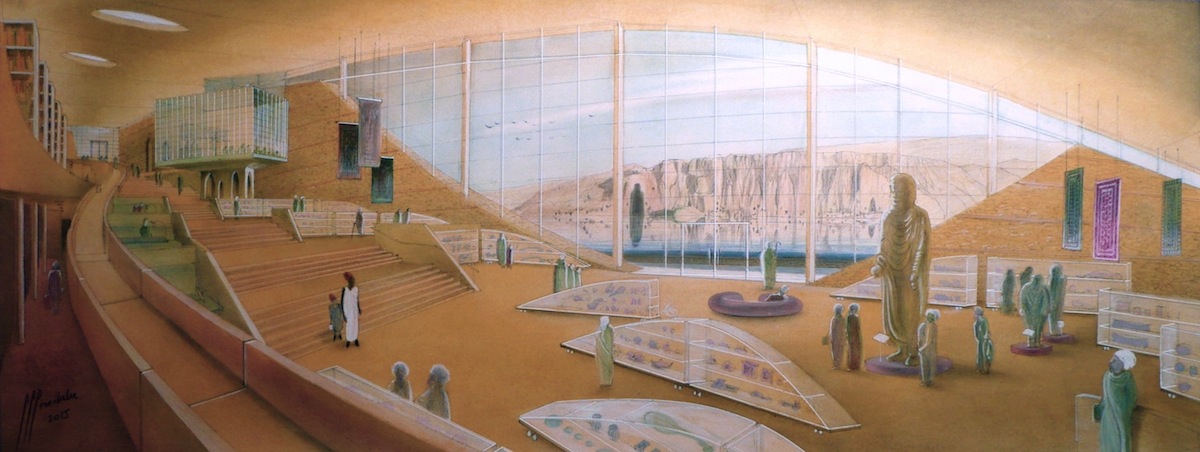
Perspective towards Buddah Cliff. Copyright © 2015 PPPouchulu
All rooms face directly the Buddah Cliff (performing, tea house, exhibition) or indirectly (research, library). The space is connected through staircases and a multipurpose central ramp. Like the Khyber Pass, that forced Afghans to be in a lifelong friction with foreigners, this building is also a passage, a statement where different cultures can share a space in peace. up
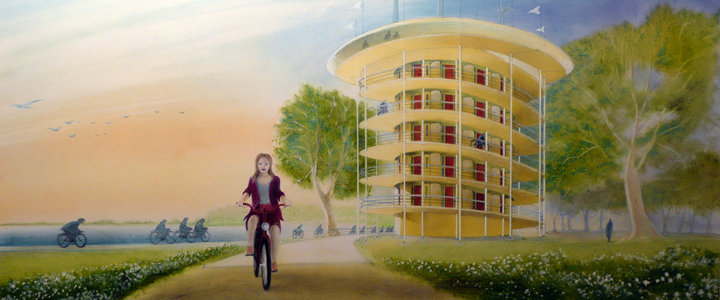
Perspective, Cyclotel unit in the Netherlands. Copyright © 2018 PPPouchulu
Cyclotel Network, Europe, 2020-30
The Cyclotel concept was created by Pouchulu in 2007. After a long research it started to be developed in 2012. It is the first shelter chain in the world to exclusively serve cyclotourists. Each unit is placed along cycling routes. The Cyclotel offers a different, new way of visiting Europe while cycling, introducing the idea of green holidays, creating short, medium or long-range trips in specialized hotels where cyclists can sleep with their bikes. Bicycles are 100% eco-friendly… represented here in a 100% green building: the first off-grid industrialized architecture network.
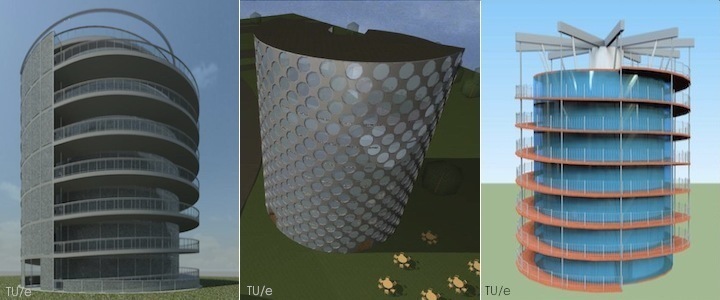
Renders, Cyclotel variations, by T/U Eindhoven Unversity, Engineeing Students, the Netherlands. Copyright © 2018 Cyclotel Holding B.V.
Round, light, modular, made of light materials, the Cyclotel is inspired in Victorian structures, following bicycle's "aesthetics": tensors, bolts, bright colours, polished details. Rooms are made of pre-fabricated wooden panels mounted on site. Each hotel can be re-located, becoming mobile if necessary when mounted in conservation areas. Energy and illuminating systems run with low-voltage in a highly ecological approach. up
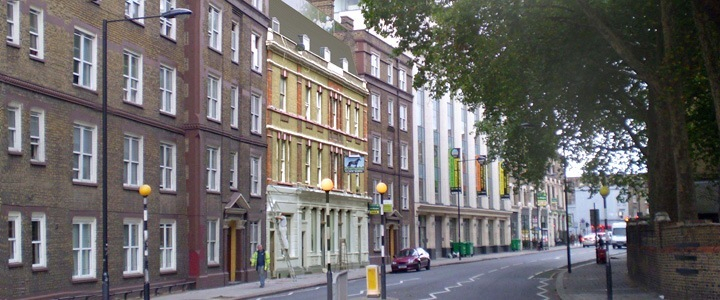
Royal Flat Appartments, Royal College Street, Camden, London. Street photo. Copyright © 2008 P.P.Pouchulu.
Royal College Street, London, 2008
In London, most contemporary architecture is hidden behind old Victorian buildings (1837-1901). The Black Horse from Kentish Town -dated 1865 and a Public House since 1775- comprised a small traditional Pub in the ground floor, plus two floors with eight bedsits (single temporary letting rooms), a maisonette and three studios at the top in the Mansard.
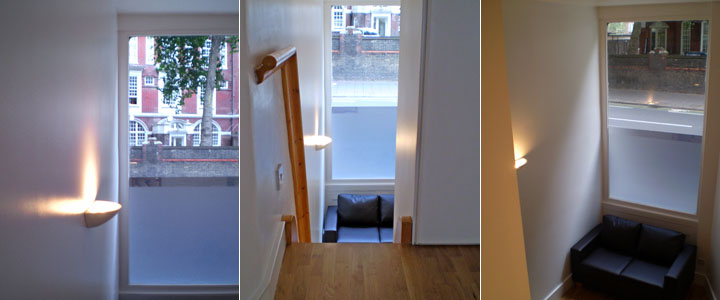
Middle flat, living & access, from mezzanine. Copyright © 2008 PPPouchulu
The Pub was converted into three flats, the first and second levels were optimised, the maisonette was transformed into a four bedrooms flatshare (street photo, left wing) and on top of the building a new proposed loft (photomontage) will capture the magnificent views of the centenary Plantans trees from across the street.
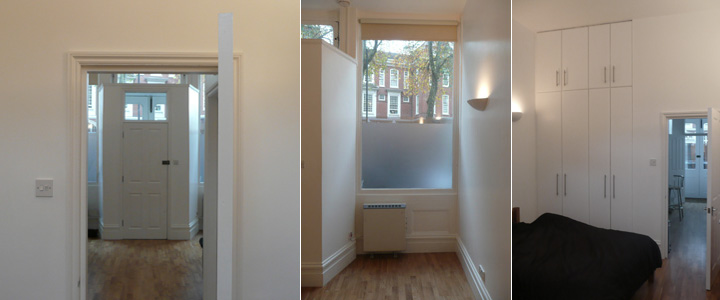
South flat, entrance porche, living's corner with original Pub's windows, master bedroom. Copyright © 2008 PPPouchulu.
After meeting Camden Council planners (the building is surrounded by a Conservation Area) the client was granted planning permission for building three new flats, completed in 2008. The top floor will be made of a pre-made steel structure wrapped with wood with a long mirrored window, placed on top with a crane without demolishing the existing Mansard.
The wooden original facade from 1865, now completely restored, hides a contemporary interior. Pouchulu refers these three flats as his Little Submarines: with only 47, 37 and 33 sqm, the use of mezzanines, vertical space, smart natural illumination and optimised circulation, bring young tenants a full functional living experience. up
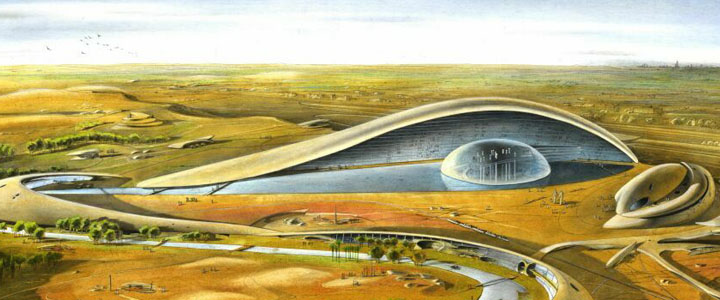
Perspective at bird's eye, showing main exhibition space, bubble-access, infrastructure buildings, Dunal Park. Copyright © 2002 PPPouchulu.
Grand Egyptian Museum, Giza, 2002
This is perhaps the most interesting competition in the first years of our new millennium: a project for the biggest museum worldwide, entirely dedicated to Egypt, just behind the Giza Pyramids. The GEM is more than a museum: it is a statement about Mankind and the Universe, as it will keep and project the treasures of our past into the future. The GEM is part of the desert and the sky: forms are curved, following the sun. It is a World, because in Old Egypt every form had a relation with the Cosmos, something we have lost.
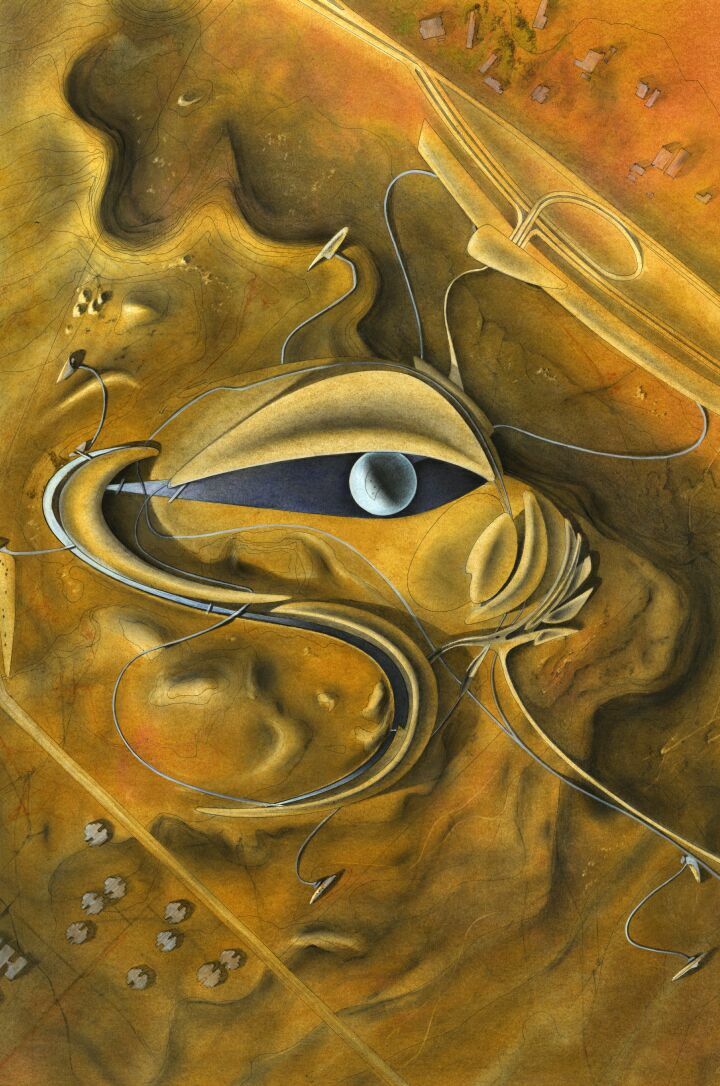
Perspective, site, showing Eye-Space, bubble-access in lake, infrastructure buildings, Dunal Park. Copyright © 2002 PPPouchulu.
The whole project is inspired in the forms of the desert and the profile of the dunes. It is organised as a suburban "garden city": a network of streets, piazzas, bridges and shells are placed surrounding the Dunal Eye, which contains the main exhibitions platforms.
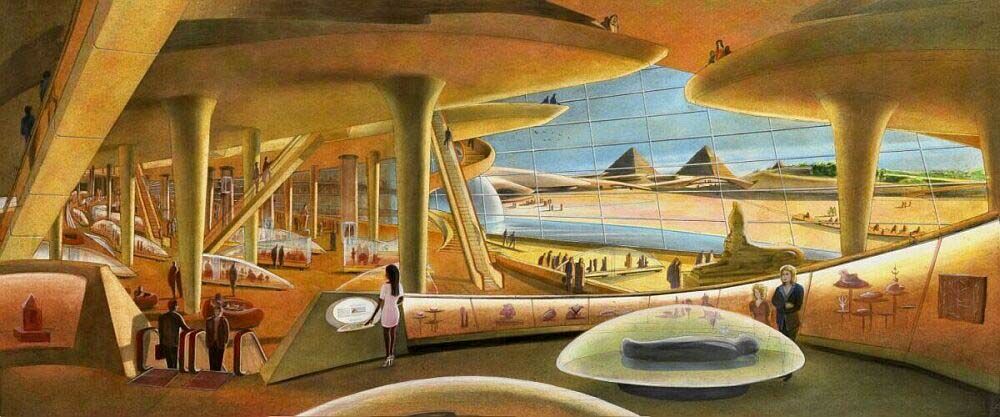
Internal perspective,exibition platforms looking at the Giza Pyramids. Copyright © 2002 PPPouchulu.
The Pyramids can be seen from every exhibition area. The inner space is defined by thematic, chronological and hyper-textual routes; different platforms are linked by bridges, lifts and escalators. Outside, a single and long curved-building contains the Conservatory, Library, Mediathequ and other resources. The main piazza is in between the Eye and a group of large spaces: auditorium (extendible with three smaller conference rooms), temporary exhibition spaces and commercial areas (restaurants, shops, leisure).

Plan, Dunal Eye, level 1, access level from Bubble (ink on film) Copyright © 2002 PPPouchulu.
The parks are organised around the Dunal Eye as extending rings, following the original topography of the site. Geometry is based on spirals, keeping dunes and depressions. The Dunal Park contains the Nile Park, which includes thematic and equipped parks. up
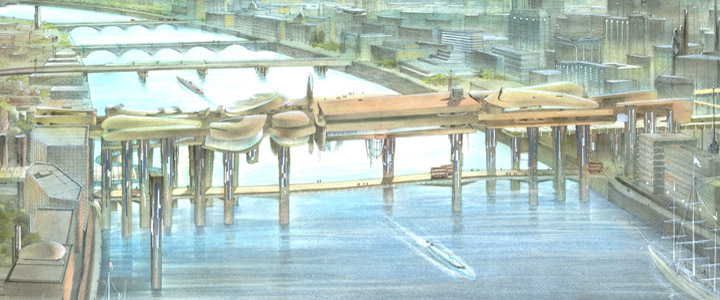
Perspective at bird's eye, London Bridge over the Thames. Copyright © 1998 PPPouchulu.
London Bridge, London, 1998
A City within a building on a bridge: that resumes the main idea of this ambitious project, linking north and south of London. Architecture becomes a transitional state between sky and water. On the main platform, several bubble spaces point the dramatic skyline; underneath, hanging glass-domes try to reach the water. It stands 65 metres over the Thames.

Perspective, the platform's belly, columns-flats and the Road Bridge over the Thames. Copyright © 1998 PPPouchulu.
This dialogue between light and space is the leitmotiv of this living bridge. It is organised along a main street, from where it is possible to see London from above for the first time.
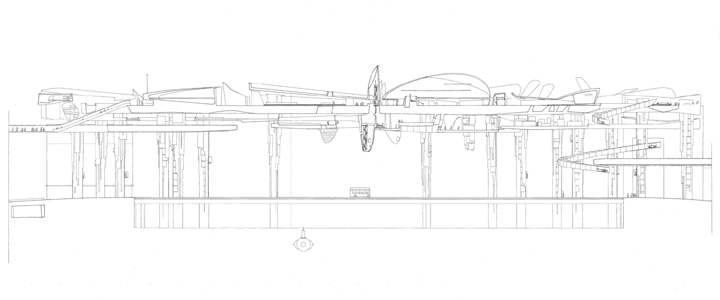
Cross Section, the Platform, Linear City, Columns-Flats, Road Bridge, Tentacles (ink on film). Copyright © 1998 PPPouchulu.
It has three elements: the platform -sort of aerial linear city on the roof level- the legs (flats) and the street bridge. The body extends into the Bank area in the shape of tentacles, which people can reach by taking lifts down in the street. up
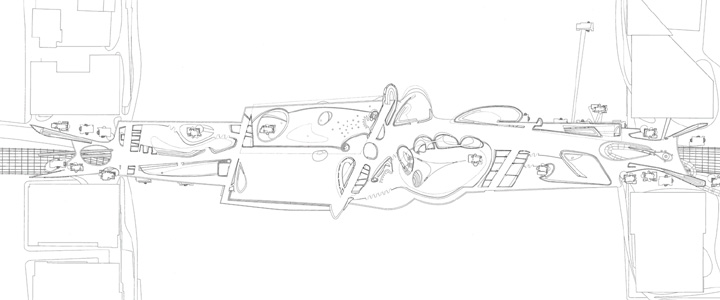
Plan, level under main linear city (ink on film). Copyright © 1998 PPPouchulu.
The idea of an alternative pedestrian urban spaces over the roofs transforms the scheme in a kind of urban machine, exploiting a different dimension.
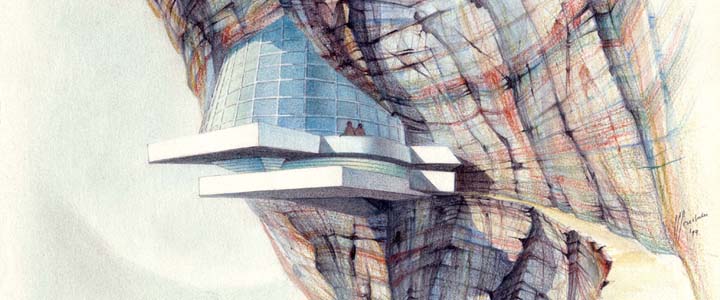
Perspective at bird's eye. Copyright © 1994 PPPouchulu.
House in a Cliff, California, 1994
This house is located in front of the ocean in a long cliff. The surfaces are clear and flat. It is a mushroom-like object, a sort of floating structure. Undoubtedly it has a Victorian spirit. The plan's geometry is based on both radial and spiral patterns. The entrance is in the middle level; the kitchen and two bathrooms are integrated within the rock; a great fireplace dominates the main living space.
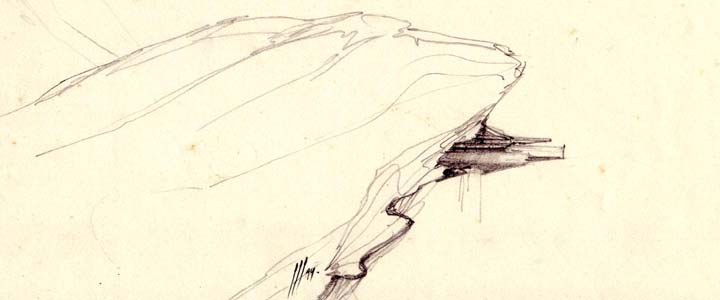
Perspective at bird's eye, East side. Copyright © 1994 PPPouchulu.
In the basement there is a comfortable bar and Chesterfield sofas, mixed with resting pods and small desks within the walls. The upper level contains a large studio-bedroom and the guest room. The interior faces magnificent views: the horizon, the cliff's sides, the morning misty air. This project is for selling. up
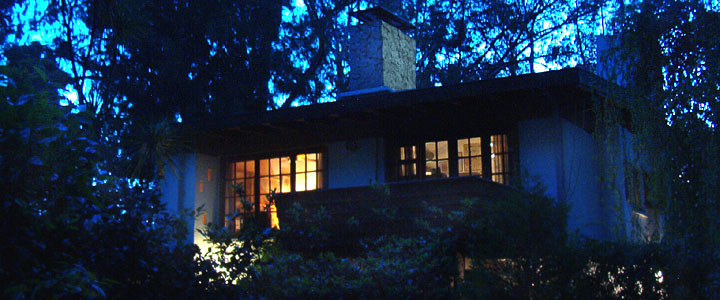
View from North-East, early evening in Spring. Copyright © 1992 PPPouchulu.
Casa Atelier, 1991/93
This house is built in a marvellous natural place covered by exuberant vegetation and forest, about 30 miles from Buenos Aires. It has two levels: public areas in the ground floor and private in the first floor. An extension, not yet built, will extend the upper floor towards the north (best orientation in the southern hemisphere).
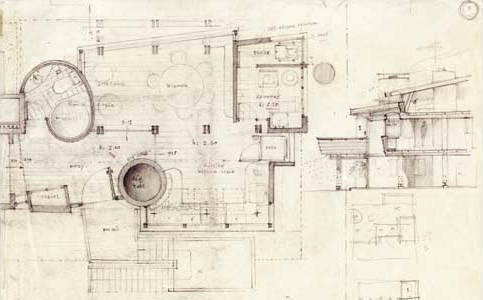
Preliminary plan for West extension. Copyright © 1992 PPPouchulu.
The views get into the space, bringing surrealistic greenish light inside. In September (spring) the whole garden blooms: millions of flowers invade the space with blue, purple and red reflections.
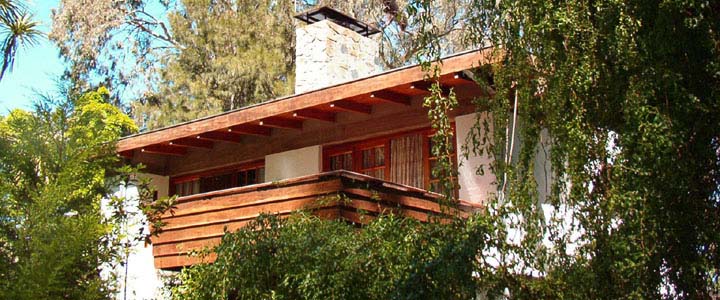
View from North-East, mid-day in Spring. Copyright © 1992 PPPouchulu.
The construction is made of insulated light bricks linked through reinforced concrete horizontal rings. The roof is made of selected hard and semi-hard timber (Lapacho, Incience, Virapita) as all the transitional spaces like the front and back balconies.
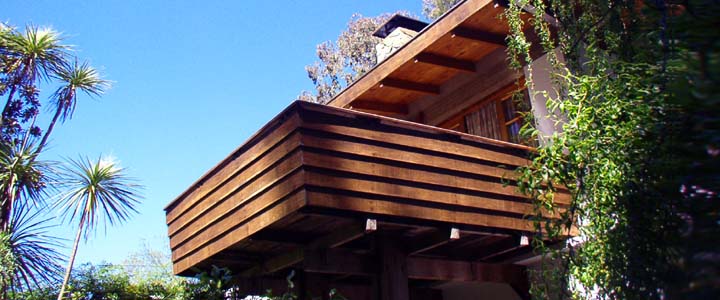
Front balcony made of Incience timber, mid-day in Spring. Copyright © 1992 PPPouchulu.
Taking advantage of availability of dry wood, a central natural convector heating system provides warm air in winter. up
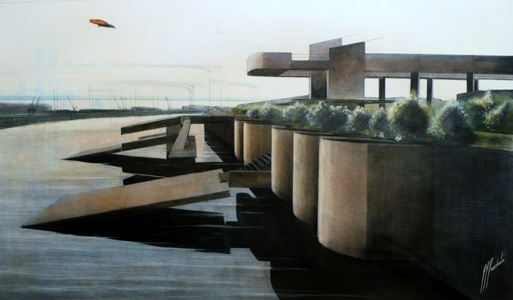
View from North-East, early evening in Spring. Copyright © 1986 PPPouchulu.
La Boca Sport Centre, Buenos Aires, 1986
This project looks for innovative ways of placing sport facilities in town. Actually, it is a concentrated urban outdoors project, a statement of territoriality: the whole complex is set as a series of mass' projections into space, land and river. The building explores as well the rational use of megastructures, taking the form of links, bridges, ramps, platforms. This project shows the idea of narrative mass. Every part, every detail is expressing itself as an individual piece of an architecture that literally tries to fly, extending into surreal spaces.

Perspective, East entrance to Residences. Copyright © 1986 PPPouchulu.
The artist's impressions show a quiet but intriguing space, somehow they guess about a closer future in a sort of "post-apocalyptical" way: greenish and bluish glossy concrete and steel surfaces appear in backlight, expressing a desire for an eternal existence.
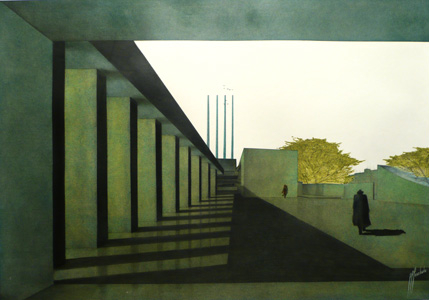
Perspective, under the pier, early Winter morning. Copyright © 1986 PPPouchulu.
A 10.000 seats stadium and ice-skate field underneath form the building's functional centre (right in the site plan); towards the river, a bridge-pier crosses the street and reaches the water in the form of floating solariums. Several facilities complement the complex (student's residences, exhibition spaces, refectories and bars.)
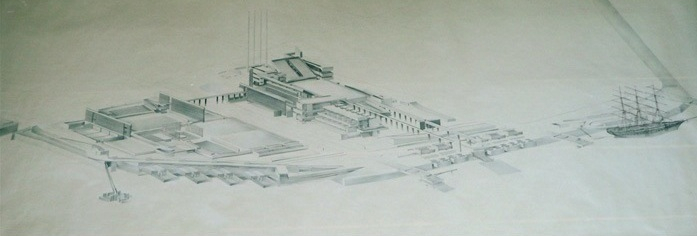
Bird's eye axonometric (pencil on heliographic copy from ink on tracing paper). 3m x 1.1m Copyright © 1992 PPPouchulu.
The second part (left) includes a main football field and two tennis and basketball fields. This part is lower and highly detached from the other by the inclusion of partition slim urban screens. up
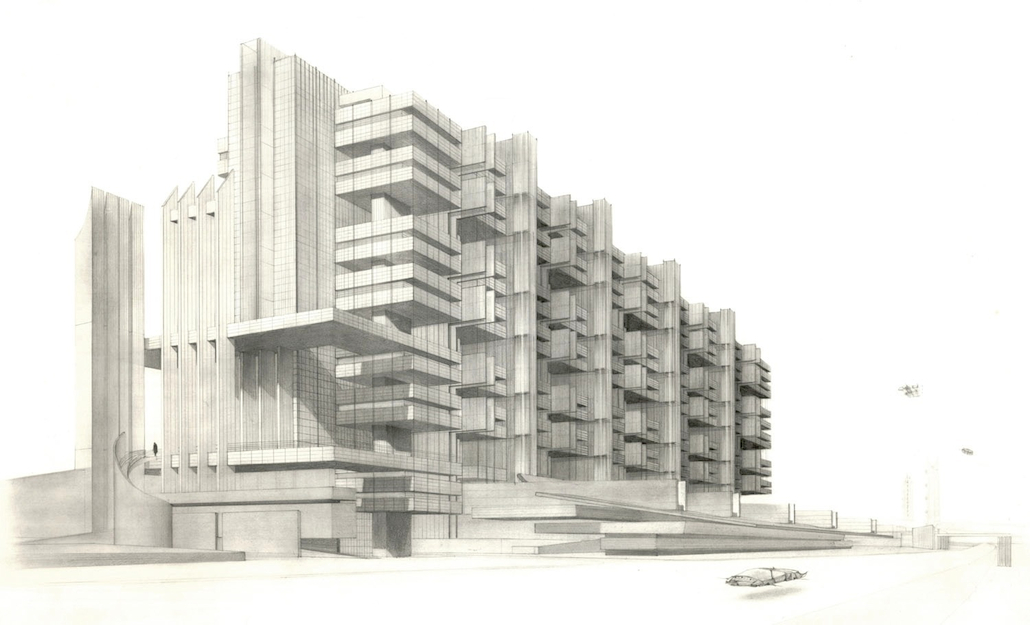
Perspective from South-East (pencil on Canson). Copyright © 1986 PPPouchulu.
Gaboto Building I, Buenos Aires, 1986
This high-rise building explores the spatial condition of a large structure and exploits the idea of detailed morphologies: the combinations of single elements shows a world of tectonic architectural shapes. Sometimes these forms are strongly set as hanging plates or floating decks, others as repetitive formalistic signs and industrial pieces. The building reacts as an organism: there are specific devices, like a sophisticated air-flap system included in between the pod-flats, designed for controlling the air condition and ventilation of the whole interior.
Preliminary drawings, Gaboto I (pencil on Conqueror). Copyright © 1986 PPPouchulu.
This project was developed in two versions; the first one (shown above) evidences a somehow rough appearance, but nevertheless belongs to a futuristic vision; the second is more descriptive: it reminds of a delicate and powerful musical composition, sort of architectonical puzzle.
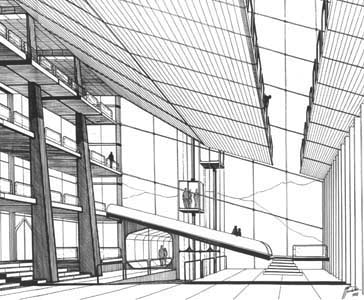
Perspective of interior space towards the West. Mountains in the foreground. (ink on canson). Copyright © 1983 PPPouchulu.
Office Building, Bariloche, 1983
This generous interior public space of an office building shows the need of expressing architecture in terms of space. The elements have been placed in a rational but free way. The transparency of the hall is expressed in the curtain-wall and in the verticality which goes up through the ceiling's gap. Structural forms fill the borders: triangular large pillars and flat platforms at the left, a textured wall at the right. The mountains profile behind the glass points the romantic condition of the space. Pouchulu was here seventeen years old.
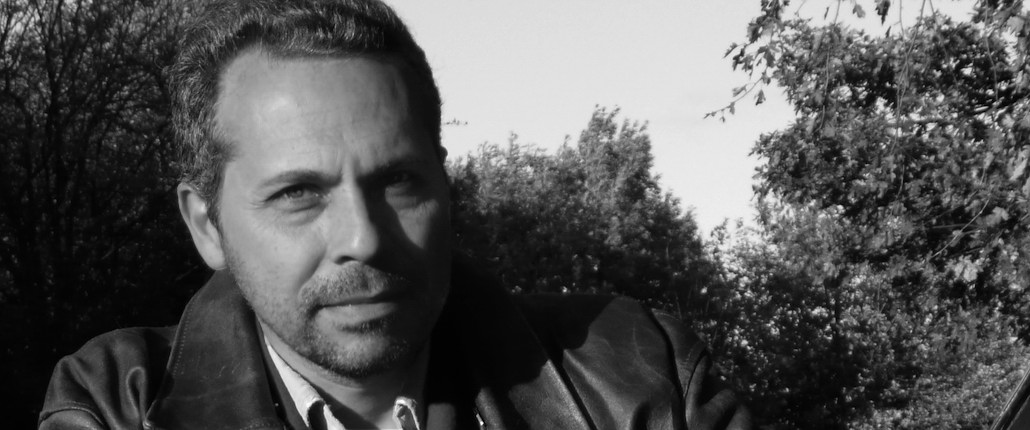
Top picture: Pouchulu in London, circa 2012. Copyright © PPPouchulu.
Contact
To contact Patricio Pouchulu click here, or send an email to: architect@pouchulu.com
Copyright © 2001-2026 Patricio Pedro Pouchulu architect